![QH_CSI_Logo_-02[4]](https://www.csi-africa.co.za/wp-content/uploads/2024/03/QH_CSI_Logo_-024.png "QH_CSI_Logo_-02[4]")


![QH_CSI_Logo_-02[4]](https://www.csi-africa.co.za/wp-content/uploads/2024/03/QH_CSI_Logo_-024-1.png "QH_CSI_Logo_-02[4]")
Definition of a Good Engine Oil:
The most essential thing that is used in car services is engine oils. Engine, or motor oil, is designed to lubricate the inner components of internal combustion engines while protecting them against corrosion and keeping them cool while in use.
An Engine oil consists of two main elements: base oil and additives. The base stock commonly makes up 80% to 95% of the blend/mixture and is either made from mineral petroleum hydrotreated base stocks, synthetic hydrocarbons, or a mixture of the two.
The base stock is responsible for the carrying of the additives to the engine’s moving parts, ensuring the control of the oil viscosity, lubricity and protection against corrosion and wear.
Engine Oil additives:
When formulating an engine oil, it is important to consider the performance as well as the viscosity requirements. Incorporating the correct additives is of utmost importance to ensure a high performing engine lubricant.
This would include both Petrol and Diesel type units. The additives used in crankcase oils are responsible for the following:
- Anti-Wear – Primarily responsible for carrying high camshaft and follower loads, oil pumps, bearings, cylinders, and piston ring protection.
- Corrosion Inhibitors – Prevents corrosion on engine components.
- Detergents – To prevent harmful deposits, particularly in the piston zone. This additive will prevent the build-up of carbon formation and “gummy” deposits.
- Dispersants – Controls harmful deposits forming compounds in the oil. These compounds are normally pulled down from the combustion chamber by the piston rings. The dispersant factor of the additive package will ensure that any deposits will be held in suspension allowing for improved filterability.
- Total Base Number (TBN) – Neutralizes acids forming in the engine (particularly found in Diesel driven engines.). Although this property of the oil is measured separately, the detergent additive also performs this function.
- Antioxidant – Prevents oxidation of the oil at higher temperatures and provides longer service life.
- Defoamant – Prevents oil foaming in the crankcase.
- Pour Point Depressant – Lowers the pour point temperature of the oil for improved low-temperature performance and flowability.
- Viscosity Index Improver – Improves the resistance of the oil to change viscosity with the increase or decrease in temperature. Lubricants containing viscosity index improvers are referred to as multigrade lubricants and do not drop as much in viscosity as monograde oils at high temperatures or increased viscosity at lower temperatures.
Engine Oil Viscosity Grades:
Engine oils are rated by their grade or viscosity. A lubricant can either be classified as a single grade that has a set viscosity, or a multi-grade, in which the oil can perform at two different viscosities depending on its temperature.
The Society of Automotive Engineers (SAE) developed a viscosity grading system, namely SAE J300, which specifies that an oil should meet a certain viscosity range at 100 degrees Celsius.
Different SAE grades are available on the market for different applications. Multigrade oils, as mentioned above, needs to meet two viscosity specifications. Their viscosity grade consists of two numbers, e.g., 15W-40, where the 15W refers to the low-temperature viscosity (“Winter”) and the number 40 refers to the high-temperature viscosity (“Summer”).
The numbers allocated to an engine lubricant do not refer to the specific viscosity of the oil at low and/or high temperatures, but is a code established by the Society of Automotive Engineers specifying the viscosity of a lubricating oil. A 15W-40 engine oil will deliver a 15 – performance at a cold starting temperature and on the other hand, it provides a 40 – performance at the normal operating temperature of the engine.
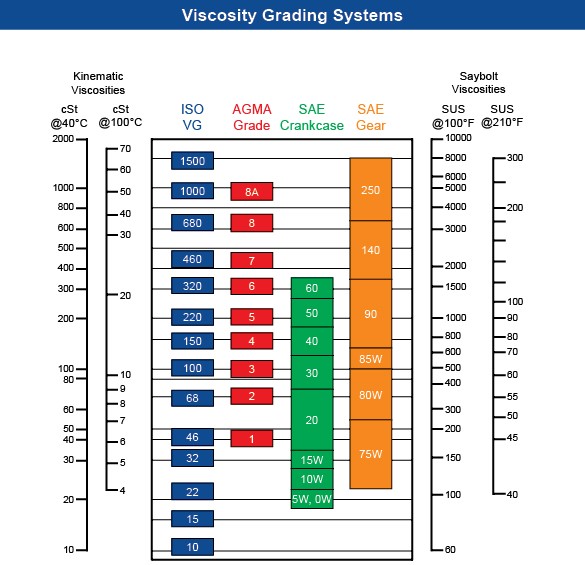
The table below can be used for reference, to compare the ISO viscosity range (ISO VG Column) to the SAE crankcase weight of an engine oil at 40 – and 100 degrees Celsius.
Engine Oil Viscosity Selection:
To choose the right lubricant for your vehicle, use the viscosity grade(s) recommended by the original equipment manufacturer (OEM) for the life of the engine and especially during the warranty period of the vehicle.
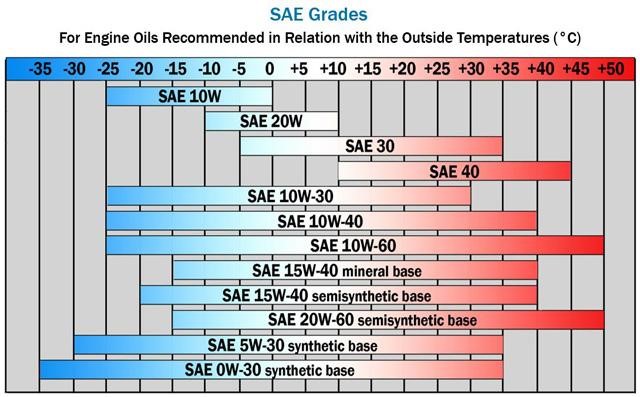
Viscosity grades are normally recommended according to the ambient temperatures, particularly the starting temperatures of the surrounding environment. An engine oil’s operating temperature does not change significantly, even in different ambient temperatures due to the water-cooling system of the vehicle regulating the engine’s optimum running temperature.
The lower the number/weight of the lubricant before the “W” (Winter), which relates to the starting temperature, will determine the lubricant viscosity, its pumpability and readiness to lubricate the engine at lower temperatures.
A 5W viscosity grade will flow easier/quicker at lower temperatures than, for example, a 15W viscosity grade, so generally, it will be used at lower starting temperatures. In tropical weather conditions, a multi-grade product such as SAE 15W-40 lubricant flows faster through the engine than a pure SAE 40 mono-grade.
The illustration below from SAE can be used as a general reference for viscosity selection based on ambient temperatures.